

Artificial Intelligence (AI) is no longer a buzzword; it’s an innovative technology that is revolutionizing the way businesses run, innovate, and compete. From automating mundane tasks to facilitating sophisticated decision-making, AI is revolutionizing sectors and creating growth opportunities at a speed unlike anything before.
By its very nature, AI enables machines to learn, adapt, and make smart decisions much like humans, just faster and more reliably.
What is Artificial Intelligence?
Artificial Intelligence is a branch of computer science that deals with developing intelligent systems with the ability to execute tasks that have always needed human intelligence. Some of these tasks are speech recognition, image recognition, decision-making, natural language processing, and predictive analysis.
With improvements in machine learning, deep learning, and NLP, AI has transformed from proof-of-concepts to practical solutions that companies and consumers use every day.

Example: AI at the forefront of digital change
Uses of AI Across Sectors
AI is no longer limited to laboratories—it’s driving the digital change in every industry:
• Healthcare – AI systems help diagnose diseases, predict patient risk, and even identify new medicines.
• Finance – AI drives fraud detection, algorithmic trading, and personalized banking experiences.
• Retail – Personalized product suggestions, demand forecasting, and AI-driven chatbots enhance customer experiences.
• Transportation – Autonomous vehicles, traffic management, and smart traffic sign recognition increase road safety.
• Maintainability – Predictive maintenance and automation streamline manufacturing and minimize downtime.
• Learning – Smart tutoring systems and adaptive learning platforms increase knowledge retention.
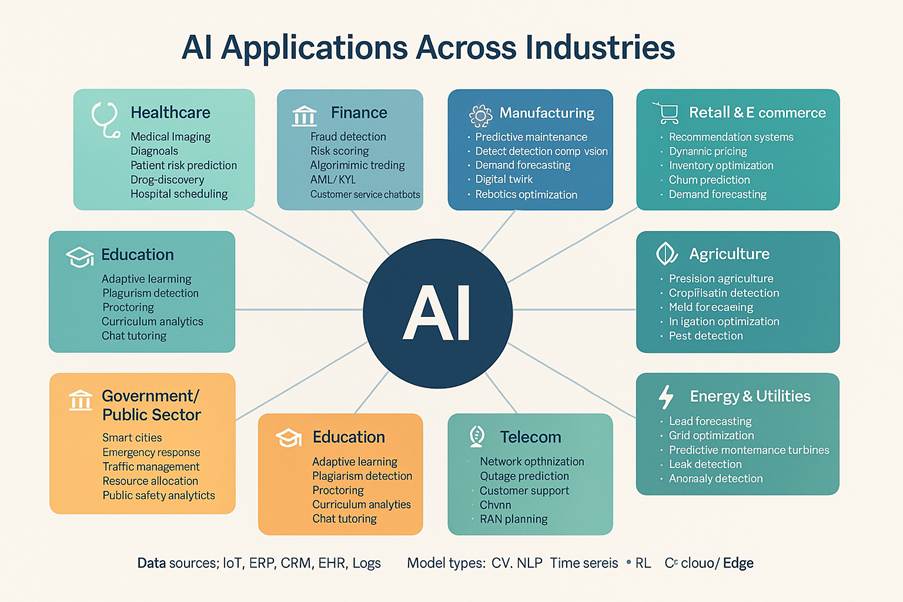
Diagram: AI applications in industries
Business Benefits of AI
Companies embracing AI technology are realizing quantifiable benefits, including:
• Operational Efficiency – Automation decreases redundant tasks and increases productivity.
• Cost Savings – Predictive analytics reduces waste and optimizes resources.
• Improved Decision-Making – Insights from data enable organizations to remain competitive.
• Customer Experience – AI chatbots and personalization enhance user experience.
• Scalability – AI solutions scale up with business, adjusting to increased workloads.
Challenges in AI Adoption
While beneficial, AI adoption is not without challenges:
• Data Quality & Availability – AI needs vast, precise datasets for it to operate efficiently.
• Ethical Issues – Concerns regarding bias, transparency, and accountability need to be addressed.
• Skill Gaps – It is difficult for most organizations to find AI talent.
• Implementation Costs – Setup and integration are costly at first for small companies.
The Future of AI
The future of AI holds smarter systems, higher levels of automation, and more integration into our daily lives. The rising areas are:
• Generative AI – Generating text, images, and code with never-before-seen creativity.
• Edge AI – Executing smart algorithms directly on devices such as smartphones and IoT devices.
• Explainable AI (XAI) – Making AI decisions transparent and trustworthy.
• AI in Sustainability – Maximizing energy efficiency and minimizing carbon footprints.
AI is not innovation alone—it’s about creating a human-centered, responsible future where technology enhances human potential.
Conclusion
Artificial Intelligence is no longer science fiction; it’s the catalyst for digital transformation, more intelligent decision-making, and emerging business models. Organizations embracing AI now will not only automate processes but also unleash innovation that shapes tomorrow.
At Cognisons, we enable organizations to leverage the strength of AI, machine learning, and intelligent automation to lead in a fast-paced digital age.